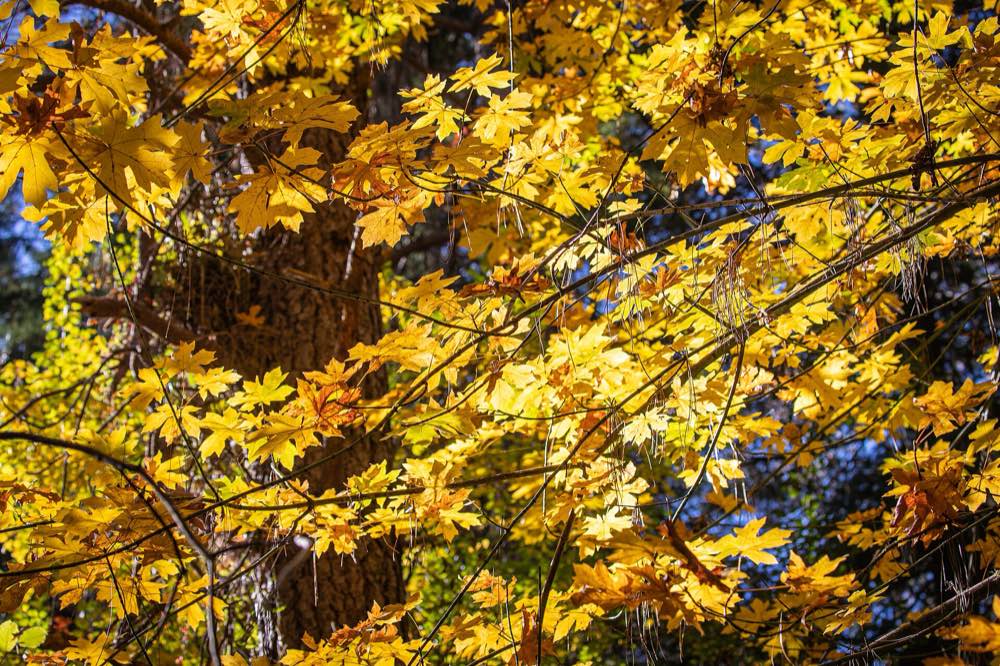
For a few weeks each year, the trees do something that makes people stop on the pavement. A maple that was plain green in August stands lit from inside. A row of beeches turns the colour of copper. A ginkgo drops a perfect yellow circle onto the grass, almost overnight.
Most of us notice, feel a small lift, and walk on. This article is an argument for not walking on quite so fast. It explains where the colours come from, why some autumns are more brilliant than others, and what research says happens to people who spend time looking at trees, and at autumn trees in particular. It ends with a small practice for the weeks that are left.
Where the colours come from
The surprising part is that the yellow was there all along. A leaf holds several pigments. Chlorophyll, the green one, does the work of turning light into sugar, and through spring and summer the tree makes so much of it that it masks everything else. The carotenoids, which are yellow and orange, sit in the same leaf all season, hidden.
What starts the change is not cold but darkness. As the nights grow longer, the tree slows its production of chlorophyll and then stops. The green fades, and the yellows and oranges that were always there show through. This is why the gold of a birch or a ginkgo is much the same every year: nothing new is being made. Something is being uncovered.
Red is different. The reds and purples come from a third group of pigments, the anthocyanins, and most of these are made fresh in autumn. As the tree seals off each leaf before dropping it, sugars are trapped inside and turned into anthocyanin. Bright light and plenty of sugar mean more of it. A red maple is, in a sense, a tree spending its last sugar on colour.
Why some autumns are better than others
Because the reds have to be made, they depend on the weather. The most vivid displays follow a run of warm, sunny days and cool nights that stay above freezing. The sun builds sugar in the leaf; the cool night keeps it there. A severe summer drought can delay the colour by weeks, and a warm spell in autumn dulls it.
So a great year is partly luck, and it differs from one hillside to the next. That is worth knowing, because it changes how you look. The red on that particular tree, this particular October, is the record of a few weeks of weather that will not come again in the same way.
What looking at trees does
The claim that nature is good for us is old. The evidence for it is recent, and it is worth being exact about what it shows.
The largest study asked nearly 20,000 people in England how much time they had spent in parks, woods and other natural places in the past week. Those who reported at least two hours were more likely to say their health was good and their well-being high than those who reported none. It did not matter whether the two hours came in one long visit or several short ones. Below two hours, no benefit showed up; between three and five hours, the gains levelled off.
This is a correlation, measured over a single week. People who feel well may simply go out more. But the pattern held for older and younger adults, for richer and poorer areas, and for people with long-term illnesses, which makes it harder to dismiss.
Is there anything special about autumn? One small study suggests the colour itself does no harm, and may help. Researchers in Canada showed schoolchildren images of the same schoolyard planted in different ways: trees in green leaf, trees in orange leaf, and bare trees. The children rated the orange trees as restorative as the green ones, and the bare trees as the least restorative. The study measured what children felt about pictures, not what happened to their attention afterwards, so it is a hint rather than a proof. Still, it says something we half know already: a tree in colour is not a tree in decline. To the person looking, it is as alive as it gets.
The part that is about attention
Being near trees is one thing. Noticing them is another, and the more interesting research is about noticing.
In one experiment, nearly 400 students were split into three groups for two weeks. One group was asked to pay attention to how the nature they met in their ordinary day made them feel: a tree at a bus stop, a bird, the sky. A second did the same with human-made things. A third changed nothing. At the end, the nature group reported more positive emotion, a stronger sense of being moved and uplifted, and a greater feeling of connection to other people. They were not asked to spend more time outdoors, only to look.
A second study tested what its authors called awe walks. Fifty-two adults aged 60 to 90 took a fifteen-minute walk each week for eight weeks. Half were simply told to walk. The other half were asked to go somewhere new if they could and to look at it with fresh eyes, attending to whatever was vast or surprising. The second group felt more awe on their walks, and over the weeks reported more feelings such as compassion and gratitude, and less distress, in their daily lives.
The limits matter here too. The group was small, healthy and well educated, and measures of anxiety, depression and life satisfaction did not move in either group. An awe walk is a way to have better days. It is not a treatment.
What these studies have in common is that the benefit came from a change in attention, not a change in circumstances. And this is where autumn has an advantage over every other season. Awe needs something new, and for most of the year the street we walk down is the street we walked down yesterday. In autumn the street changes without our help. The tree at the corner is not the tree it was last week. The season does the work of novelty for us.
Why a short season helps
There is a second reason the colours hold us, and it is that they are leaving. A green tree will be green tomorrow. A red one may be bare by the weekend. Knowing that something is about to end is one of the oldest ways of seeing it properly.
Some cultures have built customs around this. In Japan, going out to look at the autumn maples has a name, momijigari, and has been a seasonal outing for centuries, as viewing the cherry blossom is in spring. In New England people drive for hours to see the hills turn. These are not solemn occasions. They are picnics. But they rest on a serious idea: that some beauty is only available now, and that turning up for it is worth a day.
A small practice for the weeks that are left
None of this needs a forest. One street tree is enough.
- Choose a tree and visit it. Pick one on a route you already walk. Look at it each day for a minute. Watching one tree change teaches more than glancing at a hundred.
- Look up, then look down. Stand under the canopy and look through the leaves at the sky; the colour is strongest with the light behind it. Then look at what has fallen.
- Take one leaf home. Put it on your desk. Notice how many colours are in it, and how it changes over a few days.
- Walk for fifteen minutes with nothing in your ears. Once a week, go somewhere slightly unfamiliar: a different park, the other side of the river. Let yourself be surprised.
- Add it up. If you want a target, two hours outdoors across the week is the figure the evidence supports, in whatever pieces fit your days.
- Take someone. Pointing a tree out to another person is one of the quickest ways to see it yourself.
A caution for the season. As the days shorten, some people's mood drops with the light. Time outdoors in daylight is a sensible habit, but if a low mood settles in and does not lift, talk to a doctor: that is a medical question, not a matter of walking more.
What stays
The leaves will come down. In a few weeks the same branches will be bare against a white sky, and the tree will look, to a passer-by, as if nothing had happened.
But something did. For a short time, a process that goes on unseen all year became visible, and anyone who stopped could watch it. The practice is not really about autumn. It is about learning, in the one season that makes it easy, that what is in front of you is worth a minute of your attention. The colours are a good teacher because they do not wait.
Some links may be affiliate links. Read our
editorial & affiliate disclosure.
Part of our reading guide on mindfulness & meditation.