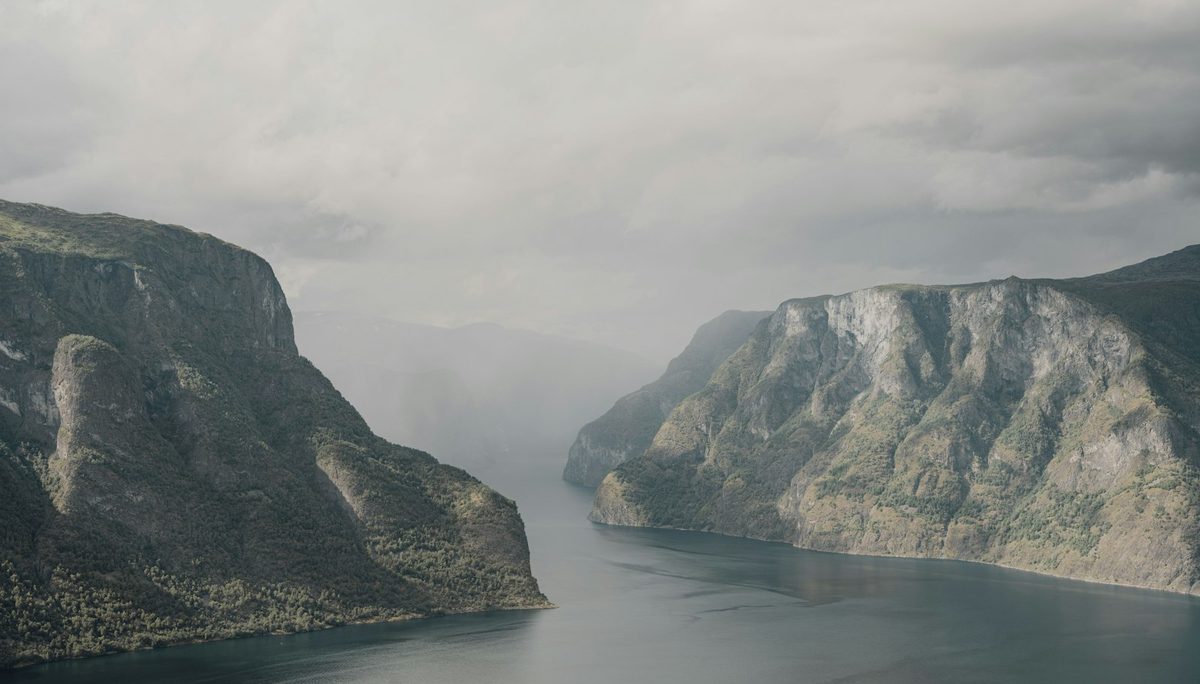
As the crow flies, Bergen and Ålesund are about 240 kilometres apart. Nobody travels between them as the crow flies. The coast in between is cut by the longest and deepest fjords in Europe, and every route is a negotiation with water, rock and ferry timetables. That is precisely the point.
This is fjord Norway at its most concentrated: a Hanseatic port, a railway that drops more than 860 metres in 20 kilometres, glaciers you can walk up to, a road of hairpin bends, and an Art Nouveau town rebuilt from ashes. This guide follows the coast north, with the detours that are worth the extra ferry.
Bergen: start in the rain
Bergen is famous for rain, and locals will tell you there is no bad weather, only bad clothing. Pack a proper waterproof and the city is a joy: compact, walkable, ringed by seven mountains and facing the sea.
Bryggen. The row of gabled wooden warehouses on the harbour was the base of the Hanseatic League's merchants for four centuries and is a UNESCO World Heritage site. Walk past the painted façades, then duck into the narrow passages behind them, where timber galleries lean at improbable angles. The Hanseatic Museum explains how German traders controlled the dried-cod trade from here.
Fløyen. The Fløibanen funicular climbs from the centre to the top of Mount Fløyen in a few minutes, for the view every postcard of Bergen uses. A return ticket costs NOK 140, or NOK 200 from April to September when bought online (prices). Walk down through the forest instead of riding back.
The fish market and KODE. The harbour-front fish market sells everything from smoked salmon to whale, at prices aimed squarely at visitors. KODE, along the Lille Lungegårdsvann lake, is one of the largest art museums in the Nordics, with an excellent Edvard Munch collection.
Give Bergen two days. It is also the natural starting point for the fjords: trains, express boats and the coastal ferry all leave from here.
Norway in a Nutshell: Flåm and the Nærøyfjord
The most famous day out from Bergen strings together a train, a mountain railway, a fjord boat and a bus into one loop. You can buy it as the "Norway in a Nutshell" package or book each leg yourself for noticeably less: Bergen to Voss and Myrdal by train, down to Flåm, by boat to Gudvangen, then bus and train back to Bergen. The full circuit takes about ten hours (route and prices).
The Flåm Railway. From Myrdal, on the high mountain line, the Flåmsbana descends from 867 metres to sea level in 20 kilometres, mostly at a 5.5% gradient, one of the steepest standard-gauge lines in the world. The ride takes about an hour and costs from NOK 399 one way. The train stops for five minutes at Kjosfossen, a 93-metre waterfall, close enough to feel the spray. Sit on the right-hand side going down.
The Nærøyfjord. From Flåm, quiet electric boats glide into the Nærøyfjord, a UNESCO-listed arm of the Sognefjord that narrows to about 250 metres, with mountains over 1,000 metres high on either side. The two-hour crossing to Gudvangen is the most dramatic stretch of the day.
Stegastein. If you can stay a night in Flåm or nearby Aurland, take the road up to the Stegastein viewpoint, a wooden platform that juts 30 metres out over the Aurlandsfjord, far below. Go early, before the tour buses.
The Sognefjord and the glaciers
The Sognefjord is the king of them all: 205 kilometres long and up to 1,300 metres deep, the longest and deepest fjord in Norway. The Nærøyfjord and Aurlandsfjord are only two of its arms. Heading north, you cross it by ferry, and the cliffs and waterfalls on either side are reason enough to stand on deck whatever the weather.
Urnes stave church. On the Lustrafjord, the innermost branch, stands Norway's oldest stave church, built around 1190 and listed by UNESCO. Its north wall carries carvings of intertwined animals older than the church itself, one of the finest pieces of Viking-age art to survive in place.
Jostedalsbreen. Between the Sognefjord and the Nordfjord lies Jostedalsbreen, the largest glacier in mainland Europe, covering 487 square kilometres. Its tongues spill into the valleys around it:
- Nigardsbreen, in the Jostedal valley, is the place for a guided walk on the blue ice. Tours run daily in summer and need no experience, but book at least a day ahead.
- Bøyabreen, near Fjærland, is visible from the main road, the easiest glacier in Norway to see.
- Briksdalsbreen, at the end of the Olden valley, is a 3-kilometre walk from the mountain lodge past roaring waterfalls.
Respect the barriers: glacier fronts calve without warning, and walking on the ice without a guide is dangerous.
Loen, Geiranger and Trollstigen
Loen Skylift. At the head of the Nordfjord, the Loen Skylift climbs from the fjord to the top of Mount Hoven, 1,011 metres up, in five to seven minutes, at up to 54 degrees: one of the steepest cable cars in the world. At the top, a restaurant and easy paths look over the fjord, glaciers and the Lodalen valley. Fit walkers can climb the via ferrata instead and ride down.
The Geirangerfjord. The Geirangerfjord is the other half of the UNESCO-listed West Norwegian Fjord Landscape, with the Nærøyfjord. It runs about 20 kilometres from Hellesylt to Geiranger, and the car ferry between the two is the best way to arrive. On the way you pass the Seven Sisters, seven parallel streams of water falling down the cliff, facing the single fall known as the Suitor. High on the ledges above sit abandoned farms such as Skageflå and Knivsflå; local lore says families once tethered their children so they would not fall.
From above. The Dalsnibba road climbs to the Geiranger Skywalk at about 1,500 metres, with the fjord a toy-sized ribbon below. Flydalsjuvet, a short drive out of the village, is the classic photo spot.
The road north. The Geiranger–Trollstigen National Tourist Route runs 104 kilometres from Geiranger to Åndalsnes. It climbs out of Geiranger by the Eagle Road (Ørnevegen), crosses the Eidsdal–Linge ferry, and finishes with Trollstigen, eleven hairpin bends down a sheer wall from 858 metres. Trollstigen opens only in summer and early autumn, roughly from late May; check before planning the route out of season.
Ålesund: a town rebuilt in Art Nouveau
In 1904 a fire swept through Ålesund and destroyed most of the wooden town centre. It was rebuilt in stone, in a few years, in the style of the moment: Jugendstil, or Art Nouveau. The result is one of the most coherent Art Nouveau townscapes in Europe, all turrets, curved gables and stylised dragons, spread over islands at the mouth of the fjords (town guide).
- Aksla. Climb the 418 steps from the town park to the Fjellstua viewpoint for the view that defines Ålesund: the rooftops and canals, the islands beyond, and on clear days the Sunnmøre Alps rising behind.
- Jugendstilsenteret. The Art Nouveau Centre, in the restored Swan Pharmacy, tells the story of the fire and the rebuilding.
- Atlanterhavsparken. One of Norway's largest aquariums, set on the shore just outside town, with the fish of the North Atlantic and, oddly, a colony of penguins.
- The islands. Undersea tunnels link Ålesund to the low, windswept islands of Giske, Valderøy and Godøya: white beaches, small harbours and sunsets over the open sea.
Ålesund is also the best base for the Geirangerfjord and Trollstigen, and its airport has direct flights to Oslo and beyond, so you can end the trip here instead of returning to Bergen.
Practical: making it work
By car or by boat. A rental car is the most flexible way to link the fjords, the glaciers and Trollstigen; public transport reaches the highlights but connections are thin outside summer. The alternative is the sea. The Coastal Express sails north from Bergen every evening and reaches Ålesund the next morning; in summer some sailings detour into the Geirangerfjord. Many travellers combine the two: Norway in a Nutshell from Bergen, a rental car through the middle, and a flight or ship out of Ålesund.
Tolls and ferries. Norway has no vignette. Cameras read your number plate at toll points and on most car ferries, so you never stop at a barrier. Rental cars usually carry a tag, and the company charges your card afterwards, sometimes weeks later, often with a handling fee. With your own foreign-registered car, register the plate and a payment card with Epass24 to avoid postal invoices and fees (how tolls work). Ferry fares depend on vehicle length; foot passengers ride many local ferries free.
Budget. Norway is expensive. Eat a big hotel breakfast, buy picnic supplies in supermarkets, and save restaurants for the evening. Card payment is accepted almost everywhere; cash is rarely needed.
When to go. Late May to mid-September is the main season: long days, open mountain roads and full waterfalls. June has the longest light; September brings autumn colours and fewer visitors. Mountain roads such as Trollstigen close in winter, and boats and buses run reduced timetables, but Bergen and Ålesund remain lovely in the snow.
An eight-day route:
- Days 1–2, Bergen: Bryggen, Fløyen, the fish market and KODE.
- Day 3, Norway in a Nutshell: train to Myrdal, the Flåm Railway, overnight in Flåm or Aurland; Stegastein at sunrise.
- Day 4, Sognefjord: ferry across, Urnes stave church, then on to the Jostedal valley.
- Day 5, glaciers: a guided walk on Nigardsbreen, then north to Loen.
- Day 6, Loen and Geiranger: the Skylift in the morning, the Hellesylt–Geiranger ferry in the afternoon.
- Day 7, the Trollstigen road: Dalsnibba early, the Eagle Road and Trollstigen down to Åndalsnes, then to Ålesund.
- Day 8, Ålesund: the Art Nouveau centre, Aksla at sunset, and the islands before your flight.
Let the weather decide
Western Norway does not follow your itinerary. A morning can start in fog so thick the fjord disappears, then open into sunlight that makes the water glow green. Leave room in the plan for that. Stay an extra night where the light is good, take the ferry you had not planned, wait out a shower in a café. The coast between Bergen and Ålesund rewards patience more than any checklist.
Prices and opening dates checked in November 2026. Confirm before you go.
Part of our reading guide on sport, play & travel.
Some links may be affiliate links. Read our
editorial & affiliate disclosure.