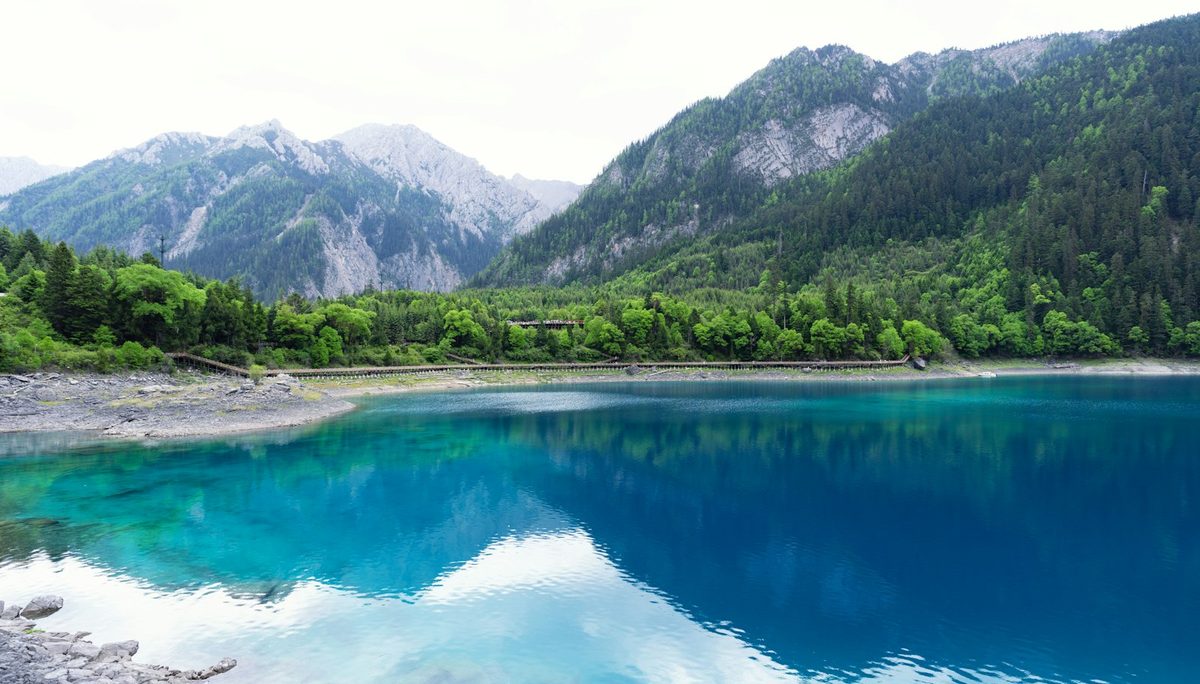
Most people come to Sichuan for the pandas and leave talking about everything else: the numbing tingle of peppercorns, the clack of mahjong tiles in a park at ten in the morning, a lake so clear you can count the stones on its bed from a boardwalk six metres above.
Sichuan is a province the size of France, tucked between the Tibetan Plateau and the Yangtze basin. Its capital, Chengdu, has a reputation across China for taking life slowly. Chongqing, its restless neighbour downriver, does the opposite. Between and around them sit some of the country's most remarkable landscapes and sacred sites.
This guide covers the places that justify the trip: Chengdu and its day trips, the Buddhist mountain of Emei, the lakes of Jiuzhaigou and the vertical city of Chongqing, plus what to eat and how to make it work in practice.
Chengdu: the city that refuses to hurry
Give Chengdu at least three days. Its pleasures are less about monuments than about rhythm: tea, food, conversation, and the art of doing very little very well.
The pandas. The Chengdu Research Base of Giant Panda Breeding is the obvious first stop, and worth it. Go at opening time (8:00 from November to February, 7:30 the rest of the year), when the bears are fed and still awake; by midday most are asleep in a tree. Tickets cost CNY 55, must be booked online under your real name up to 14 days ahead, and you show the same passport at the gate.
Teahouses. Order a bowl of jasmine or green tea at the Heming teahouse in People's Park and you can sit for the afternoon for the price of a coffee. Around you: retirees at mahjong, ear cleaners with their long metal tools, and, on weekends, the parents' "marriage market", where the CVs of unmarried children hang on strings.
Temples and old lanes. Wenshu Monastery, a working Buddhist temple, is calm and free of the crowds you would expect. Kuanzhai Xiangzi (the Wide and Narrow Alleys) is a restored Qing-era quarter: touristy, yes, but pleasant in the evening. Jinli Street, next to the Wuhou Shrine, does the same with lanterns and street snacks.
An evening of Sichuan opera. The highlight is bian lian, face changing: performers swap painted masks in a fraction of a second, a technique still guarded as a trade secret. Shufeng Yayun, in Culture Park, is the classic venue for an evening show that mixes opera excerpts, puppetry and shadow play.
Leshan and the Giant Buddha
The Leshan Giant Buddha is 71 metres of seated Maitreya cut into a red sandstone cliff where three rivers meet. A monk named Haitong began it in 713, hoping the Buddha's presence would calm waters that drowned boatmen; it took about ninety years to finish. It has been a UNESCO World Heritage site, together with Mount Emei, since 1996.
High-speed trains from Chengdu East or Chengdu South reach Leshan in under an hour. The mountain ticket costs CNY 80 in peak season. The narrow Lingyun plank road that zigzags down the cliff beside the statue is the experience, and also the bottleneck: queues of one to two hours are normal in summer, so arrive at the 7:30 opening or come on a Tuesday or Wednesday. If time is short, the 30-minute river cruise (CNY 70) shows the whole figure from the water.
Leshan sits on the way to Mount Emei, so the two combine naturally into a two-day trip.
Dujiangyan and Mount Qingcheng
Most visitors skip it. They shouldn't. About an hour north-west of Chengdu, the Dujiangyan irrigation system has been taming the Min River for more than 2,200 years, and it still works. The local governor Li Bing began it in 256 BC, and instead of building a dam, he redirected the river with three simple pieces of engineering:
- The Fish Mouth levee (Yuzui) splits the river in two. In the rainy season most of the water goes to the outer channel; in droughts most of it stays in the inner one, which feeds the fields.
- The Feishayan spillway throws excess water and silt back into the outer river when floods come.
- The Bottle-Neck Channel (Baopingkou), cut through solid rock, controls how much water reaches the plain.
The result irrigates more than 5,300 square kilometres and turned the Chengdu plain into what Chinese writers called the "Land of Abundance". It has been a UNESCO World Heritage site since 2000. Allow half a day: cross the swaying Anlan suspension bridge for the best view of the split, then climb to Erwang Temple, which honours Li Bing and his son. Entry is CNY 90.
Next door, Mount Qingcheng is one of the birthplaces of Taoism: forested paths, quiet temples and far fewer visitors than Emei. Together, the two make one of the best day trips from Chengdu.
Mount Emei: a mountain to sleep on
Mount Emei is one of China's four sacred Buddhist mountains, and the reason to come is not one view but a sequence of them: monasteries in the forest, macaques on the paths, and at 3,099 metres the Golden Summit, crowned by a 48-metre gilded statue of the bodhisattva Samantabhadra on a ten-headed elephant.
The trick is to stay the night at the top. On clear mornings the summit stands above a sea of clouds, at its best from October to February between about 6:00 and 8:00. On some afternoons, with your back to the sun at Sheshen Cliff, your shadow appears on the clouds below inside a rainbow ring, the "Buddha's halo" that pilgrims have walked here for centuries to see. Hotels at the summit start around CNY 700 in summer and fill early, so book a week or two ahead.
Practical points:
- Getting there: about an hour by high-speed train from Chengdu East to Emeishan Station (not "Emei Station", a different stop).
- Tickets: CNY 160 for the mountain in peak season, CNY 110 from mid-December to mid-January. Buses run up to Leidongping, then a cable car (CNY 65 up) finishes the climb.
- Hiking: walking from Wannian Temple to the summit takes about two days, with nights in monastery guesthouses; from Leidongping, the top is a short morning.
- Monkeys: the Tibetan macaques between Qingyin Pavilion and the monkey zone snatch food, bags and phones. Keep everything zipped, avoid eye contact, and treat any bite as a reason to see a doctor about rabies.
Jiuzhaigou and Huanglong: water the colour of gemstones
If you see one landscape in Sichuan, make it Jiuzhaigou. The valley, in the Tibetan and Qiang highlands north of Chengdu, is a staircase of lakes, waterfalls and forest between roughly 2,000 metres at the entrance and over 3,000 metres at Long Lake. The water is turquoise, emerald and sapphire, coloured by dissolved calcium carbonate and so clear that fallen trees lie visible on the lake beds.
The park is shaped like a Y. From Nuorilang, where the branches meet, the Rize valley holds Five Flower Lake and the broad, foaming Pearl Shoal waterfall; the Zechawa valley climbs to Long Lake, the highest and deepest. Green buses link the main stops and boardwalks connect them, so one long day covers the essentials. Stay nearby the night before: the park opens at 7:30 in peak season, and an early start means quieter boardwalks.
Tickets (official visitor information): from April 1 to November 15, CNY 190 for entry plus CNY 90 for the compulsory bus; from November 16 to March 31, CNY 80 plus CNY 80. Book ahead: the park no longer sells tickets at the gate.
When to go: October is the classic month, when the forests turn gold and red against the water; it is also the busiest. Late spring and early summer bring full waterfalls; winter, frozen cascades and almost no crowds at less than half the price.
Getting there: since the high-speed line opened, trains from Chengdu East reach Huanglong-Jiuzhai station in about two hours, then it is roughly 90 km by road to the park. Flights to Jiuzhai Huanglong airport take an hour but are prone to weather delays.
Add Huanglong if you can. About 100 km away, Huanglong is a valley of more than 3,400 terraced calcite pools in shades of yellow and blue, topped by the Five-Colour Pond at 3,576 metres. It is a UNESCO site, like Jiuzhaigou (both since 1992). Take the cable car up (CNY 80) and walk down. At that altitude, go slowly, drink water, and turn back if you feel a headache or nausea.
Chongqing: the vertical city
An hour by high-speed train from Chengdu, Chongqing feels like another country. It is technically not in Sichuan: it became a separate municipality in 1997. It is built on steep hills where the Jialing River meets the Yangtze, and the ground floor of one building can be the twentieth floor of the next. Chinese social media calls it the "8D city", and your map app will struggle.
What to see (city guide):
- Hongyadong: eleven storeys of stilt houses stacked against a cliff above the Jialing. It is free, and lit up from about 8pm. The best view is from the far bank or the Qiansimen bridge, not from inside.
- Liziba station: a monorail runs straight through floors 6 to 8 of a nineteen-storey residential tower. Watch from the viewing platform outside exit 2; a train passes every few minutes.
- The Yangtze River cableway: a five-minute ride across the river, once everyday transport and now an attraction. Expect long queues at weekends.
- The Mountain City Trail: a cliffside path through the old neighbourhoods above the Yangtze, a calmer view of the city than the Jiefangbei shopping district.
- Ciqikou: an old river-port town on metro line 1, best in the two hours before the lanterns come on.
- The Dazu Rock Carvings: about 80 km west, a UNESCO site of Buddhist sculpture from the 9th to 13th centuries. A tourist coach from Jiefangbei makes it a half-day trip.
Chongqing is also where Yangtze cruises through the Three Gorges begin. The classic four-day trip ends downstream at Yichang. If you only have an evening, a night cruise on the two rivers from Chaotianmen pier shows the skyline lit up.
What to eat
In 2010, Chengdu became the first city in Asia named a UNESCO City of Gastronomy. The signature is mala: ma, the tingling numbness of Sichuan peppercorns, and la, the heat of chilli. The first bite surprises; by the third you understand the fuss.
What to order:
- Mapo tofu, silky bean curd in a chilli and peppercorn sauce with minced beef, the dish that defines the cuisine.
- Dan dan noodles, thin noodles in smoky chilli oil with pork and preserved greens, eaten as a snack rather than a meal.
- Chaoshou, square pork wontons in chilli oil or a hot-and-sour broth.
- Gongbao chicken, the original kung pao: diced chicken, peanuts and dried chillies, sweeter and more balanced than the versions abroad.
- Rabbit head, braised and eaten with your fingers. A local obsession, worth trying once.
- Hotpot. Chengdu and Chongqing both claim it. In Chongqing it comes in a fiercer, beef-tallow broth; in both cities you can ask for a yuanyang pot, split between a spicy and a mild side.
If the heat is too much, ask for wei la (slightly spicy). A bowl of rice and a cold soy milk or herbal tea help more than water.
Practical: making it work
Visas. Passport holders from France and more than 40 other countries can enter China without a visa for up to 30 days for tourism, under a policy extended to 31 December 2026. As of mid-November 2026, no extension into 2027 has been announced, so check before booking a trip next year. Other travellers can use the 240-hour visa-free transit: up to ten days, with an onward ticket to a third country, entering through Chengdu or Chongqing airports. Its catch for this itinerary is geographic. In Sichuan, transit visitors may only go to 11 listed cities, including Chengdu, Leshan (for the Giant Buddha and Emei) and Ya'an. Jiuzhaigou and Huanglong, in Aba prefecture, are outside the zone, so you would need a full visa to see them.
Paying. China runs on QR codes. Install Alipay or WeChat Pay before you leave and link a Visa or Mastercard: payments under CNY 200 carry no fee, and larger ones about 3% (payment guide). Foreign cards rarely work in shop terminals. Carry around CNY 300 in cash as a backup.
Getting around. High-speed trains link everything: Chengdu to Chongqing in just over an hour, to Leshan or Emeishan in about an hour, to Huanglong-Jiuzhai in about two. Book on the 12306 app or through a travel agency, with your passport.
When to go. Spring (April to May) and autumn (September to November) are the best balance of weather and colour. Summer is hot and humid in Chengdu and especially Chongqing, but the mountains are cool. Winter is grey in the cities, quiet and cheap at Jiuzhaigou. Avoid the national holidays around 1 October and the early-May break, when queues triple.
A ten-day route:
- Days 1–3, Chengdu: pandas at opening time, teahouses, temples and an opera night; a day trip to Dujiangyan and Mount Qingcheng.
- Days 4–5, Leshan and Mount Emei: the Giant Buddha in the morning, then up the mountain to sleep at the summit for sunrise.
- Days 6–8, Jiuzhaigou and Huanglong: train back via Chengdu, one full day in the valley, one at Huanglong.
- Days 9–10, Chongqing: the vertical city, hotpot, and a night cruise on the rivers, or the start of a Three Gorges cruise.
The slow way through
The temptation in Sichuan is to rush: pandas, Buddha, lakes, skyline, next. Resist it. The province rewards the traveller who lingers over a second pot of tea, sleeps on a mountain for one sunrise, and lets dinner run long. Chengdu has a word for it, bashi, roughly "comfortable, just right". It is the best souvenir you can bring home.
Prices, opening hours and visa rules checked in November 2026. They change, so confirm before you go.
Part of our reading guide on sport, play & travel.
Some links may be affiliate links. Read our
editorial & affiliate disclosure.