On a clear day in Tangier you can see Spain. The Strait of Gibraltar is barely 14 kilometres wide at its narrowest, and for centuries that short stretch of water has made Morocco's northern tip a place where Africa, Europe and the Arab world overlap.
The north feels different from the Morocco of Marrakech postcards. It is greener, Mediterranean, shaped by Andalusian refugees and decades of Spanish rule, and Spanish is still heard as often as French. In a week you can wander Tangier's medina, buy embroidery in Tetouan's white-walled souks, swim off the long beaches of the Tamuda Bay around M'diq and Kabila, then climb into the Rif mountains to the blue town of Chefchaouen.
Tangier: the city between two continents
Tangier has spent a century being romanticised by writers and spies, and it has changed a great deal since. The old medina is still there, but the city around it now has a marina, a corniche and fast trains to Casablanca. Give it two days (what to see).
The medina and the kasbah. Enter through the Grand Socco, the busy square that joins the old city to the new, and wander down to the Petit Socco, a small square of old cafés that was the heart of the international city. Then climb to the kasbah, the highest point of the medina. Its museum of Mediterranean cultures, in the former sultan's palace, holds a Roman mosaic from Volubilis; from Bab al-Bahr, the sea gate, the view runs across the strait to Spain.
The American Legation. Morocco was one of the first countries to recognise the United States, and its old legation in the medina is now a museum: the only US National Historic Landmark on foreign soil. It is also one of the quietest, most beautiful buildings in the old town.
Café Hafa. Open since 1921, this café of terraces stepped down a cliff west of the kasbah is the place for mint tea at sunset. Nothing has been modernised, and that is the point.
Cap Spartel and the Caves of Hercules. Half an hour west, Cap Spartel is the north-western tip of mainland Africa, where the Mediterranean meets the Atlantic, marked by an old lighthouse. A short drive south, the Caves of Hercules open onto the ocean through a gap shaped like the map of Africa. Sidi Kacem beach, nearby, is the place to stay for the sunset.
Tetouan: the white dove
Tetouan is the north's least-visited gem, about an hour from Tangier. Its medina was rebuilt in the late 15th century by Muslims and Jews expelled from Andalusia, and its white walls, tiled fountains and carved wooden doors still look more like Granada than Marrakech. It has been a UNESCO World Heritage site since 1997, and unlike more famous medinas it is a working town first: the streets are organised by trade, with tanners, leatherworkers, jewellers and weavers each in their own quarter, and very few people try to sell you anything.
From 1913 to 1956 Tetouan was the capital of the Spanish protectorate in northern Morocco. The colonial new town built next to the medina, with its whitewashed avenues, balconies and the Plaza Moulay el Mehdi, still feels like a provincial Spanish city.
What not to miss:
- The Royal Palace square (Place Hassan II), the meeting point between the two cities, and the gate into the medina.
- The tanneries and the souks near Bab Mqabar, less theatrical than Fez and more authentic.
- The School of Traditional Arts and Crafts (Dar Sanaa), opposite the Bab el-Okla gate, where students learn zellige tilework, carved plaster and woodwork in a beautiful courtyard building.
- The Archaeological Museum, with finds from the Roman town of Lixus and from Tamuda, just outside Tetouan.
Tetouan is also the gateway to the beaches: M'diq is 15 minutes away.
M'diq, Kabila and the Tamuda Bay
North of Tetouan, the coast road runs along the Tamuda Bay, a curve of pale sand and calm Mediterranean water that has become the summer playground of northern Morocco. Moroccan families, visitors from Rabat and Casablanca and Moroccans living in Europe fill it in July and August; the rest of the year it is surprisingly quiet.
M'diq. The bay's main town grew up around a fishing port, and it still has one: boats land sardines, sea bream and prawns in the morning, and the grills along the harbour cook them for lunch. In summer the beach and the corniche are lively well past midnight. Restaurants are good value and the town makes the most practical base (beach guide).
Kabila. A few kilometres north, between M'diq and Marina Smir, Kabila is the bay at its prettiest: about three kilometres of soft white sand sloping gently into clear, usually calm water, ideal for children and for long swims. It is lined with beachfront hotels, beach clubs and holiday residences, and Marina Smir, next door, has a harbour full of yachts and seafront restaurants.
Cabo Negro and the Tamuda Bay resorts. South of M'diq, the headland of Cabo Negro shelters villas, golf and quieter beaches. Along the bay, a handful of large international resorts have opened in recent years for those who want a pool and a spa between swims.
When to go. June and September are the sweet spot: warm water, open restaurants and space on the sand. July and August are crowded and the most expensive time. From November to April the bay is calm and many seasonal places close, but it is a peaceful base for exploring Tetouan and Chefchaouen.
Chefchaouen: the blue town of the Rif
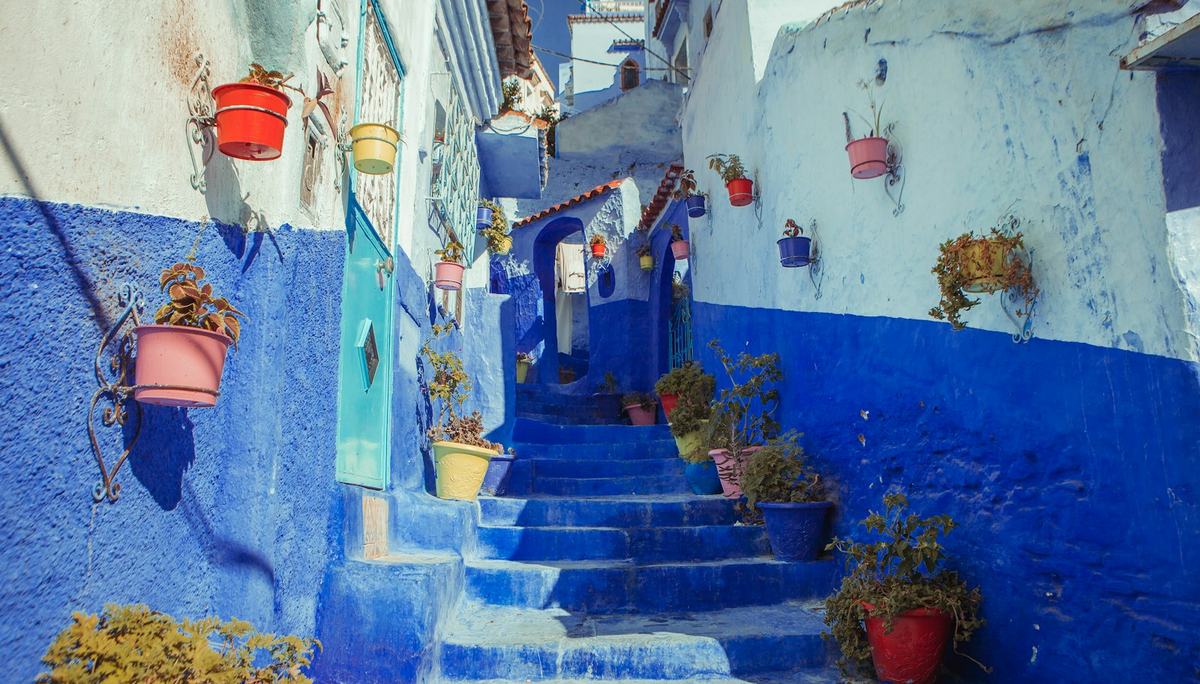
An hour and a half south of Tetouan, the road climbs into the Rif mountains and Chefchaouen appears on a hillside, every wall, step and doorway washed in shades of blue. It was founded in 1471 as a fortress against the Portuguese (weekend guide). Nobody quite agrees on why it turned blue: the houses were originally whitewashed, and the theories range from Jewish refugees to mosquito repellent to a more recent eye for visitors. It does not matter much once you are there.
The medina. The joy of Chefchaouen is getting lost. The lanes are steep, quiet and clean, cats sleep on the steps, and around every corner is another blue doorway. Everything leads back to Plaza Uta el-Hammam, the main square, shaded by trees, overlooked by the Grand Mosque and the red walls of the 15th-century kasbah, whose garden and tower are worth the small entry fee.
Ras El Maa and the Spanish Mosque. Leave the medina by Bab el-Ansar, the eastern gate, to reach Ras El Maa, the spring where the river tumbles out of the mountain and women still wash clothes. Cross the bridge and walk about a kilometre uphill to the Spanish Mosque, built in the 1920s, for the classic view of the whole blue town. Go for sunset, and expect company.
Akchour and the Talassemtane park. Chefchaouen sits on the edge of Talassemtane National Park, home to the rare Moroccan fir. A grand taxi takes you to Akchour, the start of the park's two favourite walks: up the river to a series of waterfalls and green pools, or to God's Bridge, a natural rock arch high above the gorge. Wear proper shoes and take water; both walks are best from spring to early autumn.
Stay at least one night. The town is at its best early in the morning and after the day-trippers leave.
What to eat in the north
The northern table borrows from the sea, the mountains and Andalusia.
- Grilled fish and seafood in M'diq and along the coast: sardines, sea bream, prawns and squid, bought by weight and grilled on the spot.
- Bissara, a thick fava bean soup with olive oil, cumin and chilli, the classic cheap breakfast on cold mornings.
- Jben, the soft fresh goat's cheese of the Rif, sold wrapped in palm leaves at Chefchaouen's market and served with olives and bread.
- Tagines and couscous, as everywhere in Morocco; in the north look for fish tagines and dishes cooked with preserved lemon.
- Pastries and mint tea: Tetouan's bakeries keep Andalusian recipes alive, and the mint tea is sweet and constant.
Practical: making it work
Getting there. Tangier Ibn Battouta airport has direct flights from much of Europe. From Spain, fast ferries cross from Tarifa to the port of Tangier Ville in about an hour, and from Algeciras to Tanger Med, east of the city, in about an hour and a half (ferry routes). If you are coming from elsewhere in Morocco, the Al Boraq high-speed train links Casablanca to Tangier in about 2 hours 10 minutes, with roughly hourly departures (train guide).
Getting around. There is no train between Tangier, Tetouan and Chefchaouen. CTM buses link the three towns cheaply and reliably; shared grand taxis are faster and leave when full. A rental car makes the coast and the Rif much easier, and the roads are good.
Entry. EU citizens can visit Morocco without a visa for up to 90 days, with an entry stamp on arrival (entry rules). Many other nationalities enjoy the same, but check your own government's advice before travelling.
Money and language. The currency is the dirham, which cannot be bought outside Morocco; ATMs are easy to find in towns. Cash is still king in medinas and small restaurants. Spanish is widely spoken in the north, often more than French, and a few words of Darija Arabic go a long way.
Respect. The north is more conservative than Marrakech or the big resorts. Cover shoulders and knees in the medinas and in Chefchaouen; swimwear is for the beach. Ask before photographing people, especially in Chefchaouen, where residents are tired of being in other people's pictures. During Ramadan, many cafés close during the day.
When to go. Spring (April to June) and autumn (September to October) are ideal for the whole region. July and August are best for the beaches but crowded and hot inland. Winter is mild on the coast but can be cold and wet in the Rif.
A seven-day route:
- Days 1–2, Tangier: the medina and kasbah, the American Legation, Café Hafa at sunset, Cap Spartel and the Caves of Hercules.
- Day 3, Tetouan: the medina, the artisans and the Spanish quarter, then on to the coast.
- Days 4–5, M'diq and Kabila: two lazy days of beaches, grilled fish and the marina.
- Days 6–7, Chefchaouen: the blue medina, Ras El Maa and the Spanish Mosque at sunset, then a morning walk to the Akchour waterfalls.
A slower Morocco
The north asks less of you than the south. The haggling is gentler, the distances are short, and the rhythm is Mediterranean: a long lunch of grilled fish, a swim, a walk through a blue town in the evening light. Come for the sights, and stay for that.
Checked in November 2026. Confirm timetables and entry rules before you go.
Part of our reading guide on sport, play & travel.
Some links may be affiliate links. Read our
editorial & affiliate disclosure.